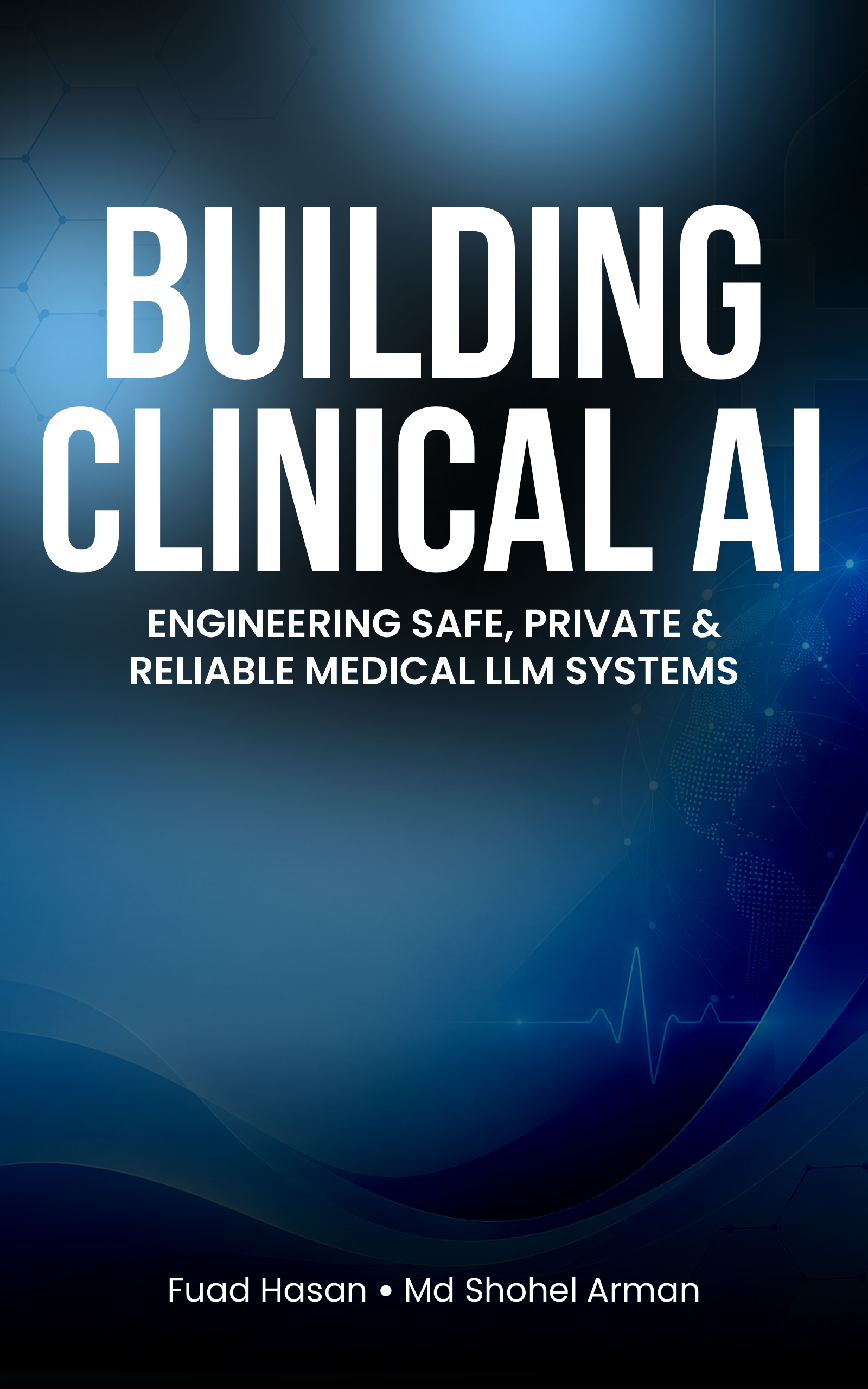
Building Clinical AI : Engineering Safe, Private and Reliable Medical LLM Systems
Building Clinical AI: Engineering Safe, Private and Reliable Medical LLM Systems is a practical guide to designing, developing, and deploying artificial intelligence systems for real-world healthcare environments. Rather than focusing only on model accuracy, this book explores the broader engineering challenges that determine whether clinical AI can be trusted in practice. It covers the responsible use of large language models in healthcare, privacy and HIPAA-aware system design, retrieval-augmented generation, clinical data pipelines, evaluation and benchmarking, hallucination control, explainability, security, human oversight, and deployment considerations. Written for software engineers, AI practitioners, researchers, students, and healthcare technology professionals, the book connects modern machine learning and generative AI techniques with the safety, reliability, and governance requirements of clinical systems. Through practical concepts and system-level perspectives, readers learn how to move beyond experimental AI prototypes toward solutions that are more transparent, secure, maintainable, and suitable for sensitive healthcare applications. The central message is simple: in clinical AI, building the model is only one part of the problem. The real challenge is engineering the complete system around it so that it can be used responsibly in the real world.
By Fuad Hasan, Md Shohel Arman
Official Amazon Author profile
Kindle · 2026-09-28 · English · ASIN B0HL9FZ17G
About this book
Building Clinical AI: Engineering Safe, Private and Reliable Medical LLM Systems is a practical guide to designing, developing, and deploying artificial intelligence systems for real-world healthcare environments. Rather than focusing only on model accuracy, this book explores the broader engineering challenges that determine whether clinical AI can be trusted in practice. It covers the responsible use of large language models in healthcare, privacy and HIPAA-aware system design, retrieval-augmented generation, clinical data pipelines, evaluation and benchmarking, hallucination control, explainability, security, human oversight, and deployment considerations. Written for software engineers, AI practitioners, researchers, students, and healthcare technology professionals, the book connects modern machine learning and generative AI techniques with the safety, reliability, and governance requirements of clinical systems. Through practical concepts and system-level perspectives, readers learn how to move beyond experimental AI prototypes toward solutions that are more transparent, secure, maintainable, and suitable for sensitive healthcare applications. The central message is simple: in clinical AI, building the model is only one part of the problem. The real challenge is engineering the complete system around it so that it can be used responsibly in the real world.
Book overview
Building Clinical AI: Engineering Safe, Private and Reliable Medical LLM Systems is a practical guide to designing and deploying language-model systems for healthcare environments where reliability, privacy, security, traceability, and human oversight matter as much as model capability. The book looks beyond the model itself and focuses on the surrounding engineering system: how clinical information is handled, grounded, evaluated, monitored, governed, and safely integrated into real workflows.
What readers will learn
- Design medical LLM systems with clear boundaries, evidence grounding, and retrieval-aware architecture.
- Handle sensitive clinical information with privacy-conscious data flows, access controls, and deployment choices.
- Evaluate reliability, hallucination risk, failure modes, and safety before real-world deployment.
- Build guardrails, human-in-the-loop review, monitoring, and operational controls around generative AI.
- Move from a promising prototype toward a maintainable clinical AI system that teams can inspect, test, and improve.
Who this book is for
- AI and machine-learning engineers building healthcare applications
- Software engineers and data scientists working with medical or clinical data
- Researchers and graduate students studying trustworthy healthcare AI and large language models
- Technical leads, product builders, and clinical-informatics teams evaluating LLM-based systems
Key topics covered
Medical LLM systems · Clinical retrieval and evidence grounding · Privacy-aware healthcare AI · LLM evaluation and benchmarking · Hallucination and reliability risk · Guardrails and human oversight · Security, monitoring, and observability · Deployment and AI governance
Why this book was written
Clinical AI is often demonstrated as a model or chatbot, but dependable deployment depends on much more than generation quality. This book was written to connect model development with the engineering decisions that determine whether a medical LLM system can be evaluated, monitored, governed, and used responsibly in practice.
Explore more from Fuad Hasan
About Fuad Hasan · Research publications · Articles and research notes · Research interests