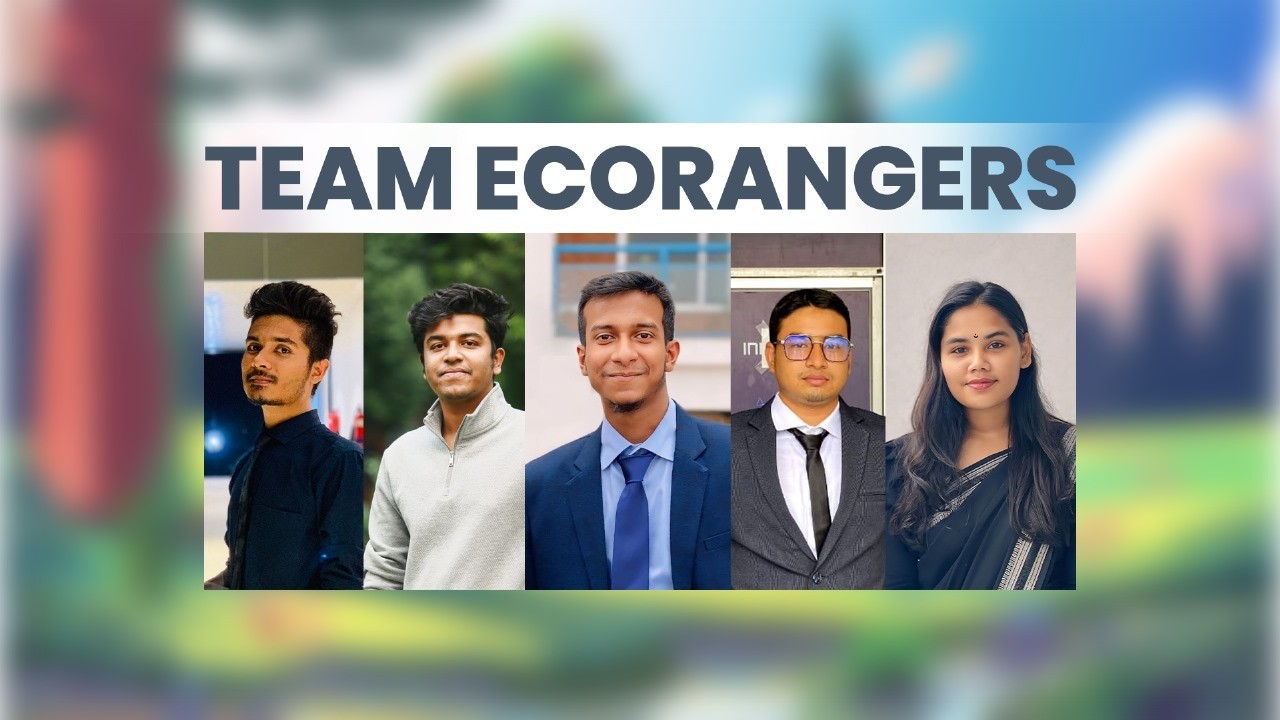
Dreaming about achieving something big is easy. Continuing that dream after rejection, uncertainty, and repeated failure is much harder. My journey in the NASA Space Apps Challenge 2024 was not a smooth story of instant success. It was a story of doubt, pressure, teamwork, feedback, late-night decisions, and the courage to begin again when everything seemed almost finished.
Today, when I look back at Team EcoRangers and our journey in the NASA Space Apps Challenge, I do not only remember the final recognition. I remember the beginning: the moment when I was told that the work I could do was ordinary, replaceable, and not suitable for a team.
The Rejection That Started Everything
My dream was simple but powerful: I wanted to participate in the NASA Space Apps Challenge. As a Software Engineering student at Daffodil International University, I had always been interested in technology, research, and solving real-world problems. NASA Space Apps felt like the kind of platform where creativity, science, open data, and impact could come together.
At first, I tried to join an existing team. With the help of my elder brother, I connected with someone who said I might be able to join their group. I waited with hope. Hours passed. Then days passed. Finally, when I asked for an update, I received a reply that hurt deeply: “The work you do can be done by anyone. Sorry, you're not suitable for our team.”
That sentence stayed with me. I started questioning myself. Was I really not good enough? Was my design ability too weak? Was I overestimating myself? But after the pain settled, another thought came: if no one gives me a place, I will build my own team.
Trying to Build a Team at the Last Moment
With only one day left before the local submission deadline, I started forming a team from scratch. I gathered four dedicated members who believed in the idea of participating. We began discussing possible project directions and how we could contribute meaningfully to the competition. Very quickly, we realized that we needed a strong developer to complete the team. We reached out to a friend, but he had personal commitments and could not join. The pressure was intense. Time was running out, our team structure was incomplete, and the project direction was still not mature enough.
At one point, we almost decided to withdraw from the NASA Space Apps Challenge 2024. It felt painful, but it also felt realistic. Sometimes dreams do not fail loudly; they quietly fade when time, people, and confidence run out together.
The Midnight Message That Changed Everything
Then, at midnight, something unexpected happened. A WhatsApp notification appeared. My professor, Khaled Sohel Mohammad Sir, had created a group for our university participants in the NASA Space Apps Challenge. When I told him that our team was out, he informed us that the deadline had been extended by four days. More importantly, he encouraged us to regroup and continue.
That moment changed the direction of everything. I took it as a second chance. I realized that success in a competition like NASA Space Apps does not depend only on having talented people. It depends on having people who are committed, available, responsible, and willing to improve under pressure.
Finalizing Team EcoRangers
After reflecting on our earlier challenges, I finalized the team with Abdullah Fahim, Saikat Hasan, and Ambia Omar Faiza. We still needed an experienced developer, and after much effort, we connected with Naim Siddiq. With him, our five-member team was complete.
That was the beginning of Team EcoRangers.
We started working seriously from the university library. There was no luxury of time. Every hour mattered. We had to understand the challenge, define the problem, divide responsibilities, prepare the project, and communicate the value of our idea clearly. We worked with urgency, but also with belief. Eventually, we submitted our preliminary round entry.
Failure Again: Not Making the Top 50
When the preliminary results came out, we did not make it into the top 50. It was another painful moment. I remember sitting with Fahim and Saikat, feeling demotivated and disappointed. After all the effort, it felt like we had fallen short again. But this time, I was not alone. My teammates encouraged me. Instead of stopping, we decided to understand why we failed.
That decision became one of the most important turning points in our journey.
The Power of Feedback
We learned about Mohammad Zaman Sir and decided to seek his feedback. After reviewing our previous work, he pointed out the weaknesses in our project. He helped us understand where our concept was unclear, where our presentation lacked strength, and where our solution needed better structure.
That feedback was not just criticism. It was direction.
We restructured our entire approach. We looked at the project from a fresh perspective. We refined the problem, improved the concept, and focused on making the output more meaningful and understandable. Later, official mentors were assigned. Initially, I tried to contact our assigned mentor but received no response. After several attempts, management reassigned us to Debabrata Mallick Sir, who gave us critical advice for improving the project further.
We were also guided by Sabila Enun Ma’am, who continuously checked in, encouraged us, and helped us stay aligned. With support from our mentors and professors, Team EcoRangers became stronger day by day.
The Struggle Behind the Final Video
One of the biggest challenges came during voice recording for our project video. It may sound like a small task, but anyone who has worked on a competition submission knows how important a clear video can be. We tried recording in the lab several times, but we could not find a quiet environment. Background noise kept ruining the takes. Time was running out, and frustration was building.
Finally, we requested permission to use the library meeting room. We explained our situation and our dedication. The administration understood our commitment and allowed us to use the space.
We recorded again and again until the output became strong enough. Ambia worked tirelessly on the voice recording, and after many attempts, we finally produced a video that represented our project properly.
The Moment Team EcoRangers Became Champion
After completing the final work, we submitted our project for the national round. Then came the waiting period. It was full of anxiety. We had already experienced rejection, pressure, and disappointment. This time, we hoped our effort would be enough. When the announcements began, my heart was racing. The second runner-up was announced. Then the first runner-up. For a moment, everything felt uncertain. Then came the moment we will never forget: Team EcoRangers was announced as champion.
That moment was more than a result. It was proof that rejection does not define the final outcome. It was proof that a team built under pressure can still rise. It was proof that feedback, dedication, and belief can change everything.
From National Champion to Global Finalist
But our journey did not end with becoming the national champion. After the national round our project was evaluated alongside winning teams from around the world. This time the challenge was even bigger. We were no longer competing only at the national level; we were representing Bangladesh on the global stage.
Then came the announcement we had been hoping for- Team EcoRangers was selected as a Global Finalist, placing among the Top 40 teams worldwide from participants across 163 countries.
For me, this was an incredibly meaningful moment. What had started with rejection and uncertainty had transformed into something I never imagined at the beginning of the journey. From struggling to find a team, to facing setbacks, receiving feedback, rebuilding our idea, becoming the national champion and finally reaching the global stage—it felt like a complete circle.
Becoming a Global Finalist was not only an achievement for our team; it was a proud moment for us as students from Bangladesh. It reminded me that where you start does not determine how far you can go. Our journey with NASA Space Apps Challenge taught me that rejection can be a beginning, failure can be feedback and persistence can turn an uncertain idea into something that reaches the world.
What NASA Space Apps Taught Me
The NASA Space Apps Challenge is not only about building a project. It is about learning how to think, collaborate, adapt, and communicate. It brings together people from different backgrounds to solve real-world challenges using NASA’s open data and space agency partner data.
As the 2026 NASA Space Apps Challenge approaches, officially scheduled for November 14–15, 2026, I believe many students will be preparing with the same dream I once had. To them, my message is simple: do not wait for perfect confidence, a perfect team, or a perfect beginning. Start with what you have, then improve with every step.
Key Takeaways from My Journey
-
Rejection can redirect you.
The first rejection hurt me, but it also pushed me to create my own team. Sometimes rejection is not the end of the story; it is the beginning of a better one. -
Team dedication matters more than team size.
A strong team is not only about skill. It is about responsibility, availability, trust, and the willingness to work under pressure. -
Feedback is a growth tool.
The guidance we received from our mentors and professors helped us see the weaknesses we could not see ourselves. -
Adaptability is essential.
We changed our approach multiple times. We faced problems with team formation, project direction, mentorship, and video recording. Each time, we adapted. -
Believe in your ability to improve.
At the beginning, I doubted myself. By the end, I understood that ability is not fixed. It grows through effort, feedback, and persistence.
Final Reflection
My NASA Space Apps Challenge journey with Team EcoRangers remains one of the most meaningful experiences of my student life. It taught me that leadership is not about having all the answers from the beginning. Leadership is about continuing when the path is unclear, bringing people together, accepting feedback, and staying committed to the goal. I am grateful to my teammates, mentors, professors, and everyone who supported us throughout the journey. From rejection to recognition, this experience shaped my confidence as a student, researcher, and future innovator.
For anyone preparing for NASA Space Apps Challenge 2026 or any other innovation competition, remember this: your first attempt may not be perfect, your first team may not work, and your first idea may not succeed. But if you keep learning, keep improving, and keep believing, your dream can still find its way.
I am Fuad Hasan, and this is the story of how Team EcoRangers turned uncertainty into achievement.